First, an apology: when I wrote Small! I didn’t think about the World Book Day costume implications of creating a character who wears stilts for an entire book. (Unless the young readers in your life go to circus school, please don’t encourage them to try it.)
Luckily, there are lots of safe ways for fans of SMALL! and SMALL BITES BACK to dress as characters from the books.
Here are some printable props you can use to become Walloping Toenail, Ms Sugar Plum or Clot the vampire dentist apprentice on World Book Day.
Walloping Toenail
Walloping’s my favourite giant. If you love him too, copy his style by:
writing the word MAPS on a piece of paper, then rolling it up and sticking it down one sock
printing out this cover for The Big Book For Explorers
cutting around the dotted line and wrapping it over another book for the day.
Cover any book to make your own Big Book for Explorers
If you have a leftover vampire costume from Halloween, you could be any of the vampire dentists in Small Bites Back. Just remember to carry a toothbrush wherever you go!
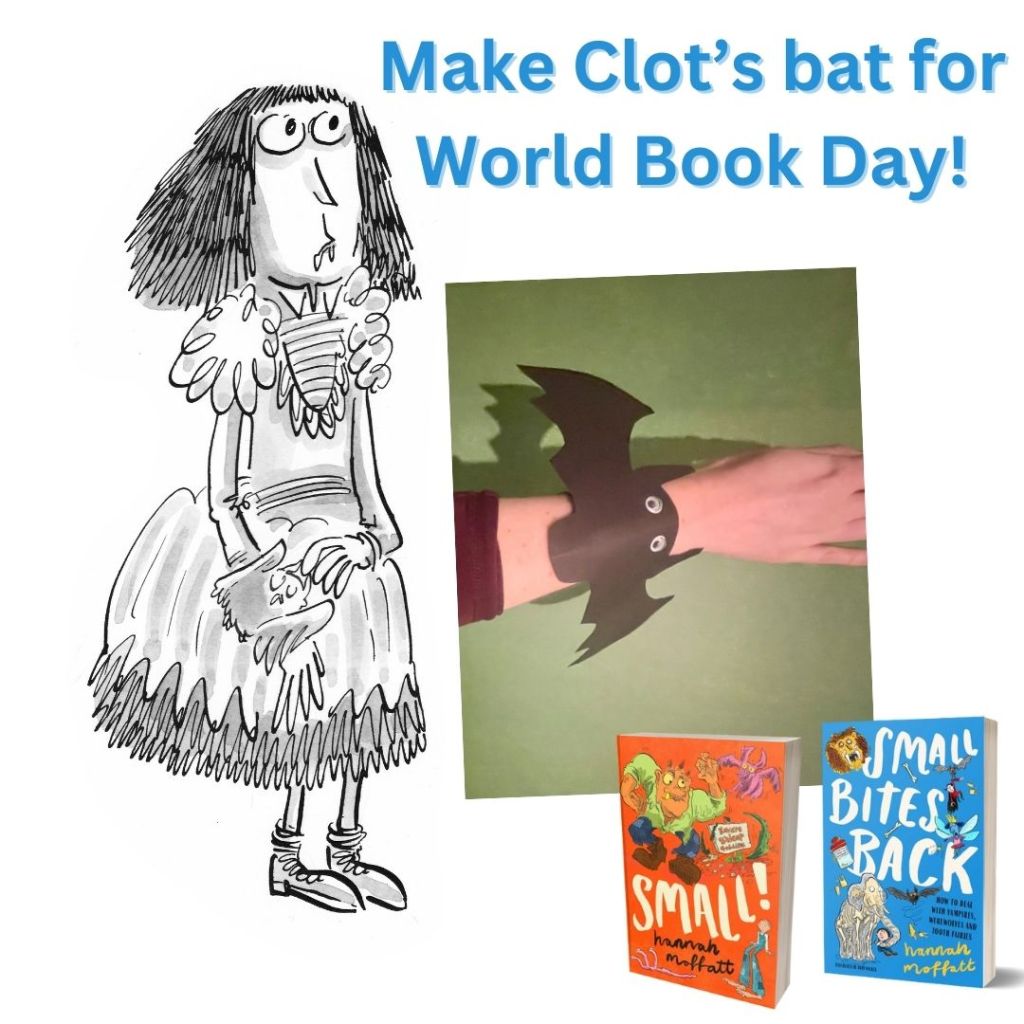
Clot also loves carrying her pet bat Fruity on her wrist. Download the template and follow the instructions to make your own flying bat wristband.
Ms Sugar Plum, the tutting, clipboard-wielding Beastly School Inspector
Fancy being a Beastly School Board inspector? Then grab a clipboard (or use the side of a cereal box and a paperclip) and print off your very own inspection report! Spend the day tutting loudly and scoring your school.
Add any extra fairy touches to your costume that you have at home, too – like wings or a sparkly tiara. You could also print and colour these wings and stick them onto the back of your outfit.
Have a brilliant World Book Day! If you dress as any Small characters, don’t forget to share your pics with me (I’m @MissDePlume on all the social media channels) 😄
If you’re a children’s author considering an author event (or a bookseller thinking about setting one up) here are a few things to bear in mind.
1.Drop-in craft works well…
If you’re not a famous author who attracts a crowd just by being there, craft events involving minimal instructions are the way to go. (I tried running structured storytelling events last year, but they’re much harder for passing kids to join in on. And if only one child arrives at the start – which isn’t uncommon for me – it puts a lot of pressure on them to come up with all the ‘answers.’)
This summer, I initially invited kids to make simple bat bookmarks. They gave me a reason to talk about the vampire dentists in Small Bites Back, but I soon realised that giving crafters one design option was a bit limiting. And since the vampire dentists love all teeth, I quickly re-branded the activity.
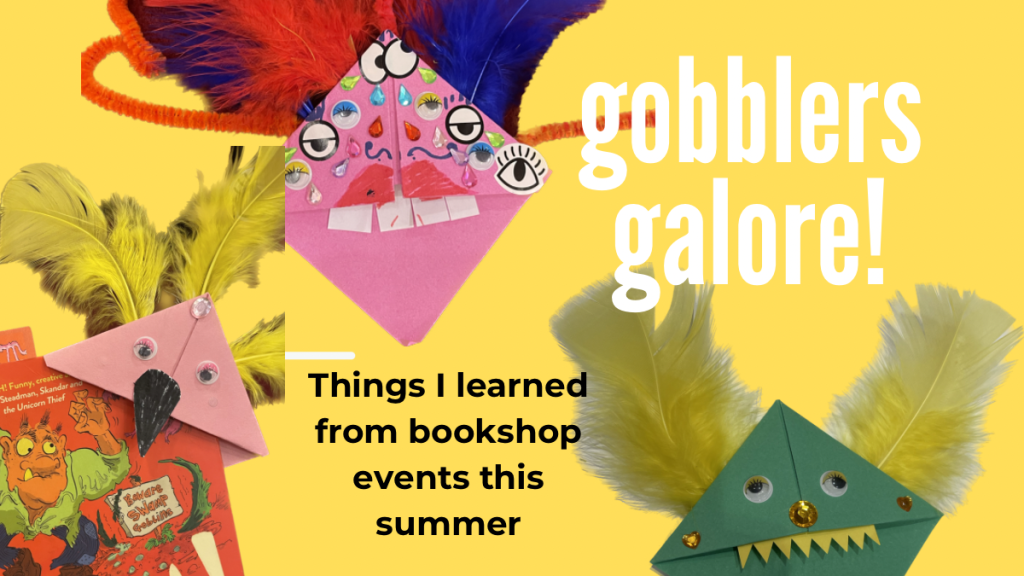
Asking kids to make book gobblers was immediately more inviting. It also meant I could fill the craft table with colourful paper, feathers, stickers and all things eye-catching (rather than piles of black paper). Kids stayed longer too as they designed their very own creatures.
…as long as people know you’re the author
I was amazed how often parents thought I was a bookseller or paid children’s entertainer. (Even when I was sitting next to a sign that said ‘author visit.’)
I’m now seriously considering buying a badge (or maybe a very big hat) that says ‘author’ on it. Failing that, my only tip for authors is to stress who you are much more than seems necessary. I did that by saying things like this:
would you like to make a book gobbler, inspired by the creatures you find in my stories?
there are all kinds of creatures in the Stinking Sinking Swamp, would you like to meet a few of the creatures I’ve created in my books?
that’s a great creature you’ve made, maybe I should write about them in my next book.
Then, as kids crafted, I asked questions that linked to bits in my books and used Rory’s illustrations as design inspiration. When the penny eventually dropped, kids and parents would stare at my books then up at me and say ,”did you WRITE these?” And the awe in their tone would give me few seconds of the deep satisfaction I always hoped would come from being an author. (Until the child went back to designing their Pokemon or Isadora Moon, totally not Small Bites Back-inspired bookmark. You can’t win them all…)
A table of gobblers in Waterstones, Sutton
2. The longer you stay, the more you sell
This is an obvious point, but not one I thought about when I was booking events. Often I’d try to ‘fit in an hour in a shop’ before doing something else nearby. And I almost always sold fewer books when I was on a deadline to leave. Or, worse still, had to go when there were still young readers coming in.
The opposite is true, too. I had a great time at Waterstones Crawley and Waterstones Bluewater, where both shops were happy for me to stay as long as I liked. I spent between 3 and 4 hours in both and left feeling like I’d really got the most from the visits. And I’d sold around 10-12 books in each, too.
3. Every visit is different
Craft event in The Book Nook, Hove
I’ve come away from shops waxing lyrical about how busy and family-friendly they were. Then other authors have visited the same shop a week later and told me it was empty (and vice versa).
Sometimes, it really is a question of luck and weather. But a couple of things help make an event work. My hands-down best event of the summer was at The Book Nook in Hove. Here are some of the things the shop did brilliantly to make it a success:
Theme: they ran themed events, every week during the holidays, so families knew what to expect, when. (I was part of monster week).
Promo: they’re excellent and consistent on social media, so people know to check their channels for event details.
Timing: they ran my event straight after a regular toddler club, so families were already in the shop.
Space: because they knew they’d attract crowds, they dedicated more or less the entire shop to the event.
Things to think about before booking an event:
I’ve had a lot of fun this summer, but there are definite pros and cons to craft events.
Pros
a chance to chat to families
a chance to chat to booksellers
it’s easier for booksellers to sell your books later once they’ve heard you talk about them
shops will order in extra copies of your books before the visit
it gives you lots of content for social media (but always get permission if you’re taking photos of kids)
Cons
buying craft materials and travelling to shops gets expensive
while you’ll sell a few books each time, you won’t match the sales from a great school visit (10 sales was a very good day for me)
sometimes, I’ll sell as many books popping in for a quick signing as I will at a full event, so you do sometimes wonder if it’s worth lugging bags full of craft gear all over the place
it takes up lots of time … leaving less time writing!
2022 was my book’s debut year and I was determined to enjoy it! Sometimes, there were big things to cheer about – like being The Bookseller’s One toWatch or The Sunday Times’ Children’s Book of the Week. (I’m well aware how lucky I am that my little book had such a great start, and I’ll be eternally grateful to my publisher for working so hard to get SMALL! in front of the right people.)
But I celebrated the quieter moments just as much. The first bookshop to share pre-order links for SMALL! (Thank you Rocketship Bookshop!). The Instagram message from a mum telling me how much her daughter loved my book. My first school assembly. Running a ‘create a swamp creature’ workshop for three boys who didn’t want to leave. And, very occasionally, readers coming to my workshops on purpose. I’ll be honest, I usually roped in any children who happened to be nearby when I was about to start.
This year has been full of little wins and whether you’re publishing your first book or fifty-seventh, holding on to those moments will make every late night editing push or plot-hole-panic worth it.
Here I am celebrating SMALL! being in the window of Waterstones Salisbury
2. Take joy in other authors acing it
I feel there’s one rule that all authors who want happy lives should follow: don’t compare yourself to other authors. If someone else has more sales, is on more shortlists or takes home more prizes, cheer for them. When a few authors in my debut group were nominated for the Carnegie, I genuinely squealed over my breakfast. One of the biggest joys I’ve had this year is seeing so many brilliant debut children’s authors doing brilliantly. And a win for any one of them feels like a win for all of us, as it shows children, teachers, booksellers and librarians are giving new, non-celebrity books a chance. That’s got to be worth cheering, right?
3. Give and share where you can
Giving your time as an author isn’t entirely selfless. When I write letters to schools, do I hope a few pupils might buy my book? Of course. When I create downloadable games and activities on my website, do I hope they’ll encourage teachers to use SMALL! in the classroom? Yup. And when I run events in bookshops, do I hope a few of the families that come will also buy my book? Absolutely.
As an author, there’s an obvious benefit to giving your time. But those little acts aren’t selling copies for me in the thousands, hundreds or even the tens most of the time. Instead, I hope they’re getting a few children excited about reading, as well as writing their own stories.
I had no idea just how much time promoting a book takes. This might vary a bit depending on the kind of marketing budget you have and whether there’s a team making resources for you. But if you’re eager to do things yourself, you could lose days:
making a website – if you’re building your own, leave lots of time for it
visiting bookshops
visiting schools
writing letters to schools
blogging, tweeting, TikToking etc
creating activities to go with your book
agonising about any of the things on that list you haven’t done yet.
I’ve loved promoting SMALL! But I’ve also struggled to get the balance between writing and promoting right. The result is that I almost always feel guilty about the things I’m not doing.
That guilt extends to the many fab books I know I’m not reading and shouting about, too. My TBR pile has never been bigger.
Going into 2023, I’ve promised to be kinder to myself and accept I can’t do everything. I’ll also try not to use promoting as an excuse to avoid the harder job of actually writing a new book…
5. Pick a good signing pen
In Goldilocks style, it took me three goes to find mine.
My first pen looked nice but the ink blotted into the pages.
My second pen didn’t blot, but the nib was too thick for my handwriting.
The third pen (a fineline version of pen two) is perfect. Here’s a pic of my Ultra Fine Sharpie in all its glory.
Third time lucky: my favourite Ultra Fine Sharpie
6. Ask for reviews
Amazon reviews – if you get over the magic 50 – help more people find your book. Even though loads of people have said lovely things about SMALL! I’m nowhere near that number.
I’ve posted occasional tweets asking for reviews and reminding everyone that you can buy SMALL! from Waterstones or your local indie and still review it on Amazon. But I’m fairly sure I’m asking in the wrong place at the wrong time.
The problem is that reviewing isn’t on most people’s radars. Before getting a book deal, I don’t think I’d ever left an Amazon review – even for books I LOVED. Looking back, I reckon my best chance to get reviews would have been to ask the parents at my events. It’s something I’ll try and do more of next year.
In the meantine, if you’re looking for a gift for me(!) or another author in your life this festive season, head to Amazon and leave a review. It won’t cost you a penny and it’ll mean the world to them.
Authors, what do you wish you’d known before you published your debut? Share your wisdom for other debuts in the replies.
No book launch party these days is complete without book cakes. These personalised vanilla sponges were just perfect. They arrived bang on time, tasted great and added a splash of colour to the snack table. EatYourPhoto deliver quickly too (which was a huge relief after the first company I tried let me down).
Customised vanilla cupcakes from EatYourPhoto.co.uk
I’ve been wearing my book necklace everywhere – especially when I know I’ll be dropping into a bookshop and asking to sign copies of Small! I’m not entirely sure what the booksellers make of me when I walk in madly pointing at my neck saying, ‘I wrote this! Honest! Can I sign it?’ But no one’s arrested me yet and, on the whole, it’s been a pretty good icebreaker.
If a writer in your life has a book out soon, and you can get your hands on the cover artwork, I’m sure a gift from NewLeaf (whether you choose the necklace, earrings or pin badge) will go down well.
Another thing that’s all the rage for authors on Instagram is book stamping. So, naturally, I gave it a try – creating a simple reward stamp that could have come straight from one of the teachers at Madame Bogbrush’s School for Gifted Giants.
And (as long as I keep the book VERY steady as I stamp) it’s worked well.* I’ve also noticed booksellers really like it. Lots have commented that children aren’t always interested in a signature squiggle, but they do like seeing the stamps.
I designed mine on Canva then loaded the design to getstamped.co.uk.
*Apologies if you’re the person who picked up my one smudged copy from Waterstones in Salisbury on my first day of stamping…
What are your favourite bookish accessories or launch day treats? Share your ideas in the replies.
You don’t need to know what the schnozzdongle does to enjoy the word immensely (although if you read the book, you’ll certainly find out). I giggled every time it appeared. And that was definitely a tip I took away: if you know a an object’s going to crop up a lot in your story, give it a good name so it’s delighting, not boring.
It also got me thinking about Richard Wiseman’s research with the Laugh Lab to find the world’s funniest joke. It was the first time I’d read about the ‘comedy k’ sound (Hard ‘c’ or ‘k’ sounds are supposedly the funniest of them all). I reckon one easy way to tell if the words you’ve chosen are funny is to try them on Word’s ‘read aloud’ tool. If they sound daft in a dull robot voice, you’re probably onto a winner.
2. Funny places
The Dangles
When I’m writing, I normally struggle moving characters from one place to another. (And whenever I can, I cheat, and jump locations between chapters.) But in Happytown Must Be Destroyed, James has made a comedic feature out of moving through the setting of Owt.
The mournful chimes of the ice cream van led us along the Woofy Wynd, round the Three Sided Square and up The Dangles.
Beginning of Chapter 20
The daft place names that pop up throughout the book made me chuckle almost as much as the Snozzdongle. Because they so beautifully mirror the way locals talk about their home towns, they also made the story of alien invasion seem so much more believable. It was a really clever way of getting me to buy into the setting. It also reminded me that little details can make a big difference to a story. You don’t need to describe every inch of your world. In this case, cracking local dialect brings the whole thing to life.
3. Existential musings on the nature of happiness
Yes, this book is packed with gags galore, but there’s a big message about what it means to be happy running through the story, too. Is jumping around in a yellow tracksuit looking happy, the same as actual happiness? Spoiler: probably not.
I love a comedy contrast and this book is full of them. We’ve got ice cream vans with guns. We’ve got Leeza, the indecisive allergy-sufferer who’s somehow been tasked with saving the town. And we’ve got the entire story: a comedy romp that genuinely makes you think about what it means to be happy. It’s yet another example that funny isn’t the opposite of serious. Amidst all the fun, there are big messages to take away … along with even bigger smiles.
Happytown Must Be Destroyed is published by Hachette Children’s Group and it’s out now.
Just after Small!’s cover reveal, I changed my homepage. I thought I’d been really clever by duplicating the page rather than starting from scratch. My plan was to redesign the copy in the background, then do a grand switcheroo on Cover Reveal Day. And it would have worked wonderfully, if I’d remembered to update my menus.
But I didn’t. So if you clicked ‘home’ in the top navigation from another page, you ended up back on my old homepage instead. On the plus side, my site doesn’t get many visitors yet, so I’m not sure anyone noticed 😂
2. Pre-orders
Use a ‘Link in bio’ template for pre-orders
I’d seen other authors putting all their pre-order links on a Linktree page and assumed I needed one, too. But, thanks to a free WordPress webinar, I learned about the Link in Bio template. It looks just like a Linktree page but doesn’t take traffic away from your website. Now that’s the page I’m linking to on my Twitter profile – in the hope that anyone ordering a book (fingers crossed) might stick around to read the odd blog or invite me to a literary festival…🤞🏻
My Link in Bio page
3. Get the look you want
Avoid my design mistakes with a ‘Full Site Editing’ template
WordPress have just launched a new suite of templates that look much easier to edit than this one. With the older templates, there are some things I just can’t seem to change (like the vast amounts of white space between my content blocks). With Full site editing you can control everything – dragging boxes to make them the size you want. As soon as I can bring myself to do it, I’ll make the move to a new template. Full site editing is still in beta at the moment, so it might be worth waiting a little while for WordPress to iron out any kinks. But from what I’ve seen in the demo, it looks really user-friendly, even for beginners like me. It works on WordPress.com and .org but since I still haven’t made the move to .org, the new templates could well keep me where I am for a bit longer.
I’m still learning so much about web design, and this site is far from perfect. But WordPress webinars have been really helpful. If you’re with them, I recommend signing up to get a few extra tips. (You can also take a look at this blog from me.) Good luck!
When we’re still filled with festive cheer and the stress of the day job is a distant memory, it’s easy to set rigid writing goals. Sticking to them when reality bites is a whole different matter.
So, in 2022, I’ve decided NOT to set a daily word-count goal, or even to commit to writing daily. The chances are, I’ll still write most days because 1) I love it, 2) I feel genuinely sad when I’m not writing. But if work or life gets in the way sometimes, I won’t be beating myself up about it.
Instead, I’ll write my socks off whenever I can, and I’ll stay focused on big overall goals (like writing a sequel and pitching a non-fiction book). Then I’ll get there in whatever way I can, no matter how scrappily.
Fill your notebooks
Notebooks are there to be written in. (Yes, even the ones with the fancy hardback covers and gold sprayed edges.) This year, I refuse to be intimidated by the beauty of a notebook, and neither should you. It’s your words that make notebooks valuable. Fill them. Fill them. Fill them.
A few of the notebooks I plan to fill this year
Be the writer only you can be
In 2022, I’m going to try really, really hard not to compare myself to other writers, or read their books and come away thinking things like, ‘Their words are so beautiful, I wish I could write lyric poetry…’
Instead, I’ll cheer and champion every writer’s brilliance (something I try and do already). Then I’ll get back to being the chaotic, daft and generally bonkers writer I already am.
It’s easy to dismiss your own writing style, especially if it comes easily to you. For ages, I thought ‘well anyone could write like this, everyone else must be choosing not to.’ It’s only really since early reviews have come in for my debut middle grade book, Small! that I’m starting to think that my particular brand of storytelling might actually be my strength.
Whatever your writing style, I hope you embrace it in 2022. I’ll be right here to cheer you on.
Good luck.
(PS if you fancy reading a bit of bonkers MG, you can pre-order Small! with the lovely Rocketship bookshop.)
What are your writing resolutions? Share them in the replies
Proof copy for Loki: A Bad God’s Guide to Being Good
1. It’s a diary, done differently
Play with form
Who doesn’t love a diary? They’re the perfect place to enjoy the comedy antics of unreliable or naive narrators. (Emer Stamp’s, The Unbelievable Top Secret Diary of Pig is another of my all-time comedy favourites for that reason.) But what’s so smart about Loki’s diary is that he’s not allowed to lie. Every time he tries, the diary ‘helpfully’ writes back with its own corrections. It’s a brilliant device. And it’s a great reminder that no matter how familiar your format, there’s always a way to twist it and make it your own.
2. It’s funny because it’s true
Find the funny in front of you
As an outsider to the modern world, Loki is the perfect observational comedian. He’s constantly questioning the absurdity in the everyday, giving us his views on everything from work, school and shopping to crisps and – my favourite – museums. Loki can’t believe how boldly museums display their stolen goods (he’s far too sneaky to make his own wrongdoings so obvious).
Loki’s insights into life cracked me up and got me thinking. Mostly, they reminded me of the GK Chesterton quote that funny doesn’t have to be the opposite of serious. Loki’s comedy definitely has a serious side.
Funny is the opposite of not funny, and nothing else.
GK Chesterton
3. It brings new life to old stories
Build on what we know
We get a few specific nods to the original Norse myths, but Louie mostly uses them as a springboard for fresh silliness. I especially enjoyed Thor (who’s on Earth as Loki’s brother to keep an eye on him) wanting to spend his weekends admiring hammers in the DIY shops.
Using things we already know (or learn in the first couple of pages) sets the stakes high from the start. Will Loki, the misbehaving trickster god, ever manage to live a virtuous life? Or will Odin punish him to an eternity in a chamber filled with snakes?
This isn’t a retelling of the myths. It’s dropping familiar characters into new settings and asking the question that gets all the best stories going: ‘What if..?’ It’s also a brilliant way to go from a blank page to a fresh, funny and completely original new story.
I was rooting for Loki from the start. I’m sure everyone else will, too.
Loki: A Bad God’s Guide to Being Good publishes with Walker Books in February 2022. Pre-order yours now. (That’s my Bookshop.org page, but I’m sure you can order it in your local indie, too.) #BeLessLoki
I thought signing with an agent would make getting published plain sailing. Alas, when the book that bagged my agent didn’t bag a publisher, I learned things don’t always work that way.
Luckily, by the time the rejections came through, I was totally immersed in the new project that became SMALL! So although the ‘no’s were disappointing, I was having enough fun in my new giant world to keep my chin up. That’s the big thing I’d recommend to anyone going on submission: always have another project on the go.
2. There’s probably a long wait ahead
Find a debut community
The next thing I hadn’t realised was how long you have to stay quiet about your book deal once you’ve signed it. (It was about eight months for me, but when telling the world about your book deal is the most exciting thing to have happened to you in the history of the world ever, those months feel like years.)
To handle the wait, find other writers who are waiting, too. I joined a Twitter group for 2022 debuts and it’s been the best place to quietly chat about the ups and downs of the publishing journey.You can see what the group’s up to (when we’re allowed to share news) by following @2022Debut on Twitter and Instagram.
My debut was announced to the world yesterday. And, for now at least I’m allowing myself time to grin widely, skip wildly and check Twitter ever so slightly obsessively (I’ve been overwhelmed by the love and excitement people are showing SMALL! on social media. The kidlit writing community really is the best).
There are tough days in this writing game, but boy are the good days glorious.