Categories
Practical tips

I’m back on the Little Blog of Library Treasures 😀

Categories
Practical tips Writing Life

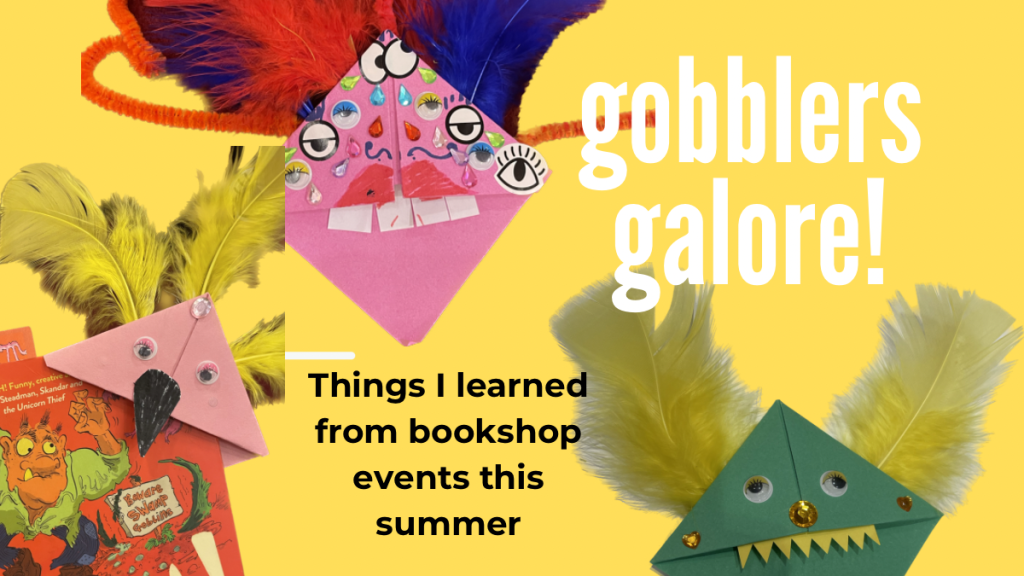
Gobblers galore!

If you’re a children’s author considering an author event (or a bookseller thinking about setting one up) here are a few things to bear in mind.

If you’re not a famous author who attracts a crowd just by being there, craft events involving minimal instructions are the way to go. (I tried running structured storytelling events last year, but they’re much harder for passing kids to join in on. And if only one child arrives at the start – which isn’t uncommon for me – it puts a lot of pressure on them to come up with all the ‘answers.’)

This summer, I initially invited kids to make simple bat bookmarks. They gave me a reason to talk about the vampire dentists in Small Bites Back, but I soon realised that giving crafters one design option was a bit limiting. And since the vampire dentists love all teeth, I quickly re-branded the activity.

Asking kids to make book gobblers was immediately more inviting. It also meant I could fill the craft table with colourful paper, feathers, stickers and all things eye-catching (rather than piles of black paper). Kids stayed longer too as they designed their very own creatures.

I was amazed how often parents thought I was a bookseller or paid children’s entertainer. (Even when I was sitting next to a sign that said ‘author visit.’)

I’m now seriously considering buying a badge (or maybe a very big hat) that says ‘author’ on it. Failing that, my only tip for authors is to stress who you are much more than seems necessary. I did that by saying things like this:

  • would you like to make a book gobbler, inspired by the creatures you find in my stories?
  • there are all kinds of creatures in the Stinking Sinking Swamp, would you like to meet a few of the creatures I’ve created in my books?
  • that’s a great creature you’ve made, maybe I should write about them in my next book.

Then, as kids crafted, I asked questions that linked to bits in my books and used Rory’s illustrations as design inspiration. When the penny eventually dropped, kids and parents would stare at my books then up at me and say ,”did you WRITE these?” And the awe in their tone would give me few seconds of the deep satisfaction I always hoped would come from being an author. (Until the child went back to designing their Pokemon or Isadora Moon, totally not Small Bites Back-inspired bookmark. You can’t win them all…)

A table of gobblers in Waterstones, Sutton

This is an obvious point, but not one I thought about when I was booking events. Often I’d try to ‘fit in an hour in a shop’ before doing something else nearby. And I almost always sold fewer books when I was on a deadline to leave. Or, worse still, had to go when there were still young readers coming in.

The opposite is true, too. I had a great time at Waterstones Crawley and Waterstones Bluewater, where both shops were happy for me to stay as long as I liked. I spent between 3 and 4 hours in both and left feeling like I’d really got the most from the visits. And I’d sold around 10-12 books in each, too.

Craft event in The Book Nook, Hove

I’ve come away from shops waxing lyrical about how busy and family-friendly they were. Then other authors have visited the same shop a week later and told me it was empty (and vice versa).

Sometimes, it really is a question of luck and weather. But a couple of things help make an event work. My hands-down best event of the summer was at The Book Nook in Hove. Here are some of the things the shop did brilliantly to make it a success:

  1. Theme: they ran themed events, every week during the holidays, so families knew what to expect, when. (I was part of monster week).
  2. Promo: they’re excellent and consistent on social media, so people know to check their channels for event details.
  3. Timing: they ran my event straight after a regular toddler club, so families were already in the shop.
  4. Space: because they knew they’d attract crowds, they dedicated more or less the entire shop to the event.

Things to think about before booking an event:

I’ve had a lot of fun this summer, but there are definite pros and cons to craft events.

  • a chance to chat to families
  • a chance to chat to booksellers
  • it’s easier for booksellers to sell your books later once they’ve heard you talk about them
  • shops will order in extra copies of your books before the visit
  • it gives you lots of content for social media (but always get permission if you’re taking photos of kids)
  • buying craft materials and travelling to shops gets expensive
  • while you’ll sell a few books each time, you won’t match the sales from a great school visit (10 sales was a very good day for me)
  • sometimes, I’ll sell as many books popping in for a quick signing as I will at a full event, so you do sometimes wonder if it’s worth lugging bags full of craft gear all over the place
  • it takes up lots of time … leaving less time writing!

And just to prove those cons haven’t put me off…

I still have a couple more events in the diary:

Sunday 8th Oct

You can catch fellow author Chrissie Sains and me in a crafty double act as part of the Maidstone Literary Festival. We’ll be in the Maidstone Waterstones from 1pm to 2.30pm.

Wednesday 25th Oct

And I’ll be back in Waterstones Ashford for some spooky crafts from 11am-12.30.

Then I’m zipping over to Waterstones Canterbury to do the same thing again from about 2pm.

Categories
Practical tips

Writing courses

Before I wrote for children, I was already a writer. I’ve been scribbling ads, reports, brochures and web copy pretty much since I left uni.

So writing a children’s book would be a doddle, right?

Wrong.

I wouldn’t have got anywhere fast without three marvellous courses to help me on my way.

1. Start the book

City Lit’s Writing for Children

City Lit run lots of affordable courses for children’s writers (and since the pandemic, most have moved online).

But it was Lou Kuenzler’s Writing for Children courses that helped me start writing and keep writing.

Lou’s published heaps of brilliant children’s books , so she knows what she’s talking about, and can empathise with the trials and tribulations of finding agents, going on submission and holding your nerve as you wait (seemingly endlessly) for news.

She runs a course for beginners as well as a writing workshop, which is pretty much the best critique group imaginable. Lou’s an extraordinarily perceptive and constructive critic and creates just the right atmosphere to encourage everyone else to give useful feedback, too.

Lou’s an extraordinarily perceptive and constructive critic

As well as finishing my first children’s book with Lou, I met many a brilliant word-wrangler and friend.

Recent alumni include:

2. Stay inspired

Masterclass

I’m a massive Neil Gaiman fan, so when he designed a course for Masterclass, I was there. His words of wisdom always give me a lift. (My favourite being a reminder that if an early reader tells you something isn’t working, they’re probably right. And if they tell you how to fix it, they’re probably wrong.)

But Neil’s not the only reason I’ve stuck with my subscription.

If I’m ever after a fresh perspective, I bypass the writing courses and listening to the many actors, composers, comedians and artists on the site instead.

A bit like the old trick of reading your writing upside down to spot mistakes, looking at creativity from a different angle has a knack of unlocking knotty problems for me.

Of the three courses on here, this one’s the least interactive (for me). Technically it comes with forums and workbooks, but I can’t resist simply sitting back and enjoying the beautifully shot videos.

3. Edit the book

CB Creative’s Edit and Pitch your Novel

After finishing my first manuscript and getting a fair few agent rejections, I decided my book wasn’t quite as finished as I thought. And I turned to Curtis Brown’s 6-week online course for help.

Anyone can sign up, not just children’s writers, and the online platform made it easy to get to know people.

Within a couple of lessons I realised my book REALLY wasn’t finished

Within a couple of lessons, I realised my book REALLY wasn’t finished and, using CB’s excellent editing technique, I embarked on a major rewrite.

As well as helping you look at structure, the course covers perfecting your synopsis and agent cover letter. I also took the option to pay for an editor’s report at the end to get feedback on my whole submission package.

Before the course, I’d only had form rejections from agents. After it I came away with two full requests and found my agent!

If you’re not sure why your submissions aren’t working, I can’t recommend this course enough.

Have you been on any brilliant writing courses you’d recommend? Leave a reply to share the love